Pages

Monday, 10 April 2017

The best investigation in science!

Plan:
  • What we do
  • Things we needed
  • Science
Material:
  • 100mls beaker with milk
  • 15mls beaker white vinegar
  • Eye drop
  • Tripod
  • Burner
  • Gauze
  • Thermometer
  • Wet cloth
  • Empty beaker
  • Matches
  • Stirring rod
Steps:
  1. Use a burner and use wet cloth to wipe around it, then use a tripod and Gauze top of it then get the burner and gently put it under the tripod.
  2. Take of the lid from the burner and  place it beside you then light the burner using the matches to light it up.
  3. Take the 100 mls of milk beaker, thermometer and place it on the tripod and the gauze, while doing that you hold the thermometer and place it gently in the beaker of milk then wait until it goes up to 37 temperature heat.
  4. Take the 100mls beaker of milk away from the tripod and gauze then off the burner.
  5. Take the beaker that is 15mls of white vinegar and use the eye drop to pour 12 drop of vinegar in the beaker of milk.
  6. then stir it and while you are stirring it with the stirring rod.
Then finally you should have a baby spit milk the produces moluques.

Observation:
When the energy heat warm the 100mls of milk the heat should be 37 temperature and when the 15mls of white vinegar in mix up with the milk it produces moluques ,solid and smells like cheese.
Image result for danger sign


Danger:

Kids don’t try this on your own.

Friday, 24 March 2017

It is really interesting to learn about science!

Technicraft
Brainstorm
  • What we did
  • Things we got
Materials for science investigation:
  • 40 mls beaker
  • 30 mls beaker
  • Acetic acid(vinegar)
  • Sodium bicarbonate(baking soda)
  • Ziplock bag
Steps:
  1. Get a beaker filled with 40 mls of sodium bicarbonate, another beaker filled with 30 mls acetic acid (vinegar) and a ziplock bag. Getting another person is recommended in this experiment.


  1. Get a ziplock bag and pour in the sodium bicarbonate and make sure your partner is holding the ziplock bag and then get the acetic acid and pour in and then make sure your partner has closed the bag.


  1. Carefully shake it, inside the ziplock bag, a chemical reaction will take place.


Observations:
When the baking soda (Sodium bicarbonate) and the vinegar (acetic acid)  mixed up together it caused a chemical reaction. The reason for this was because when the sodium bicarbonate mixed up with the acetic acid it created a foam and the ziplock was filled up with carbon dioxide (CO2).


Safety:
Be careful if you try this, you should have an adult with you.

Danger!!!

Friday, 10 March 2017

Some facts about fish drive!


I am learning how to persuade people to make a change! By using direct language to inform but also make readers make a change

Thursday, 9 March 2017

Recalling my day at Technicraft!

Today at tech we went straight into our work and had an instruction that we need to get our pencil, ruler, rubber and our folder. Then we had the next instruction that we need to get our work sheet and write in the things that we need, pencil, ruler and red pen.

After that we folded the sheet to horizontal and underneath the sheet we had a instruction that we needed to fill up the things that we need. When we finished our work, we learnt about Solid,Liquid and gases.


But in the same time we also got a chromebook to share with our partner. Then we first login and we did an activity about liquid that liquid cannot stay in its position. When we finished the quiz we had to shut down the chromebook and write down what we learnt about Solid,Liquid and Gases.


When we finished packed up and came peacefully back to school.Image result for solid ,liquid and gas

Friday, 17 February 2017

Learning about bubbles!

Materials needed:
  • Straw
  • Container
  • Pencil
  • soap


Today at Tech, the year 7 were officially welcomed to Pakuranga intermediate in a Powhiri.
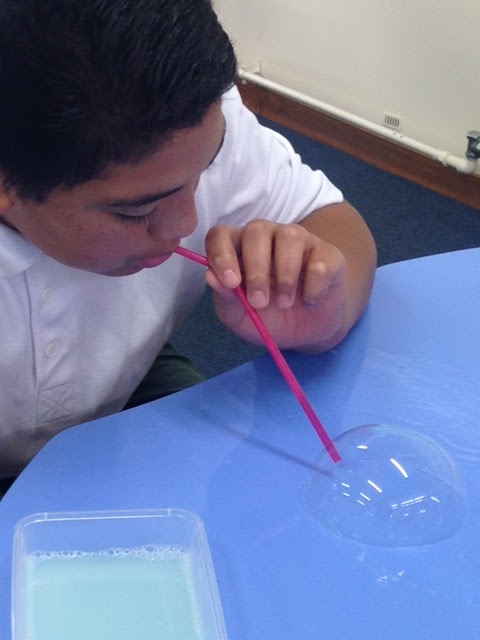
Following this we returned to our science class where we learnt about bubbles that can stay in shape when the air outside and inside is pushed ( forced ) against each other.


Our teacher, Miss Gawith, gave us instructions to use a straw and tip it in the container fill up with water mixed up with sugar and soap and blow a bubble on the table.


When she finished giving us instructions, we started to blow a bubble into another bubble. It was so exciting to watch the bubbles. Next, we had to check our hypothesis to see if it was correct or wrong. When we finished checking our hypothesis. We had to blow another bubble and time it how long it floated. My bubble took two minutes and 53 seconds because of the surface tension.

IMG_2076.JPG